Hackers poison arrayref Rust crate to push infostealer malware
Hackers compromised the maintainer account behind the widely used Rust crate arrayref to introduce malware that executed on developers’ systems during compilation. […]

Hackers compromised the maintainer account behind the widely used Rust crate arrayref to introduce malware that executed on developers’ systems during compilation. […]

Search for “how to fix a bloated Excel workbook,” and you’ll find plenty of familiar advice. But the real problems are often hiding in places you never think to look. Here’s where to check before you assume the problem is Excel itself.

The U.S. has charged 17 Iranians, alleged members of a hacking-for-hire company called Mabna Institute, involved in years-long operations that stole data from American organizations. […]

More than once, I’ve thought a USB port on my PC was broken. It only turned out to be true once, but when it was, I was actually able to fix it.

The FBI said Tuesday that the Medusa ransomware gang has breached more than 500 critical infrastructure organizations in the United States since June 2021. […]

Apple has released security updates for more than two dozen security vulnerabilities across iPhone, iPad, and macOS Tahoe,including yet another image parsing vulnerability that could compromise your device.
This update delivers security fixes that were first made available in the iOS 27 and iPadOS 27 betas.
The table below shows which updates are available and points you to the relevant security content for each one.
| Name and information link | Available for |
| iOS 26.6.1 and iPadOS 26.6.1 | iPhone 11 and later, iPad Pro 12.9-inch 3rd generation and later, iPad Pro 11-inch 1st generation and later, iPad Air 3rd generation and later, iPad 8th generation and later, and iPad mini 5th generation and later |
| iOS 18.7.10 and iPadOS 18.7.10 | iPhone XS, iPhone XS Max, iPhone XR, iPad 7th generation |
| macOS Tahoe 26.6.2 | macOS Tahoe |
| visionOS 26.6.1 | Details coming soon |
For iOS and iPadOS users, here’s how to check if you’re using the latest software version:
Go to Settings > General > Software Update. You will see if there are updates available and be guided through installing them.
Turn on Automatic Updates if you haven’t already—you’ll find it on the same screen.
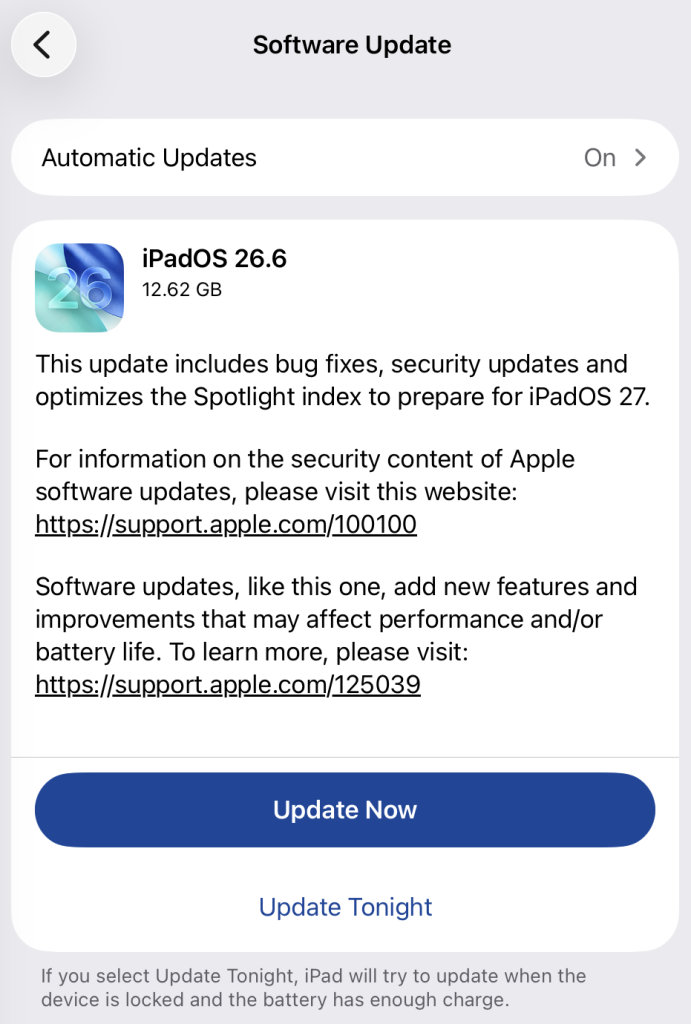
To update macOS on any supported Mac, use the Software Update feature, which Apple designed to work consistently across all recent versions. Here are the steps:
Of the 27 vulnerabilities, CVE-2026-65346 is the one that stands out. It is an ImageIO integer-overflow bug in which merely processing a malicious image may result in arbitrary code execution, a substantially stronger stated impact than the many “crash-only” findings in this release.
ImageIO is Apple’s framework that handles image parsing. An integer overflow means the vulnerability lets a malicious hacker trick the program into performing an integer operation where the result exceeds the allocated memory space. This can lead to attackers running malicious programs or gaining elevated privileges. In this case, it allows the attacker to run code on the target’s device.
There is no indication in Apple’s advisory that CVE-2026-65346 or any other listed vulnerability was exploited in the wild, but cybercriminals will often try to reverse engineer the patch to come up with an exploit, or the researchers who found it will post a proof-of-concept once everyone has had a chance to apply the update. At that point, these vulnerabilities can be used against you.
Scammers know more about you than you think.
Malwarebytes Mobile Security protects you from phishing, scam texts, malicious sites, and more. With real-time AI-powered Scam Guard built right in.

Security controls can block a familiar attack method while missing quieter ways to achieve the same objective. Picus Security’s Blue Report 2026 shows how prevention rates can vary dramatically by technique and why behavioral testing is needed to uncover those gaps. […]

You don’t need a Mercedes badge to get the things that make a luxury SUV feel genuinely luxurious. The Genesis GV80 focuses on the details you’ll actually notice from the driver’s seat, including a quiet cabin, a comfortable ride, supportive seats, and a refined driving experience.

Microsoft Defender’s latest patch bypass shows a familiar problem.
A newly disclosed Microsoft Defender flaw called ShieldBreak shows that fixing one attack path doesn’t always close every route to the same result.
Microsoft has assigned ShieldBreak the identifier CVE-2026-69414 and confirmed it is an elevation of privilege (EoP) vulnerability in the Microsoft Malware Protection Engine. Microsoft says it is still working on a security update.
If that sounds somehow familiar, you’re probably thinking of RoguePlanet, another vulnerability in Defender that Microsoft acknowledged on June 16 and patched on July 8.
At the time, the published exploit for RoguePlanet was described as depending on a race condition, meaning it was not guaranteed to work the same way on every machine. That was one reason the vulnerability was concerning but still somewhat limited from a practical point of view.
Microsoft’s July fix should have closed the door on that problem. But security fixes do not always eliminate a weakness at the root of the problem. Sometimes they block one known attack path, while a researcher later finds a different route to reach the same end result.
That appears to be what happened here. ShieldBreak has been described as a patch bypass because it reportedly sidesteps the earlier RoguePlanet fix, although it uses a different exploitation method rather than simply repeating the original attack.
In August, the same researcher disclosed ShieldBreak, and Microsoft responded by publishing a new advisory for CVE-2026-69414.
The advisory says the issue has been publicly disclosed, proof-of-concept (PoC) exploit code exists, exploitation is considered more likely, and no official fix is available yet. Microsoft says it is working on one.
Until Microsoft releases a fix, the most important protection is preventing untrusted code from running on your computer in the first place. ShieldBreak is a local privilege escalation issue, so an attacker first needs some level of access to the machine.
Based on the best public reporting available right now, ShieldBreak appears to require Microsoft Defender to be enabled in order to work. Public testing indicates that the exploit does not succeed when Defender is off or when another product is registered as the active antivirus provider.
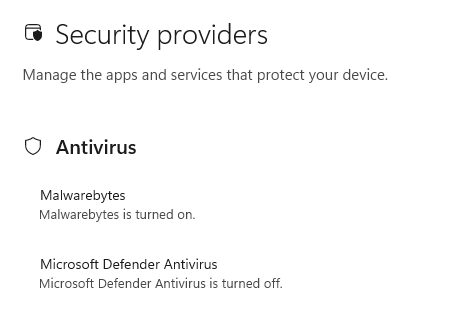
So, narrowly speaking, disabling Defender appears to stop this specific ShieldBreak chain from working. However, that is not a good safety recommendation for most people. Turning off your antivirus removes an important layer of protection and could leave your computer exposed to other attacks.
For home users, all that means:

According to CNET. Read their review ?

GitHub is down for some users as a widespread outage is causing errors across the website, API, Actions, Pull Requests, and several other services. […]